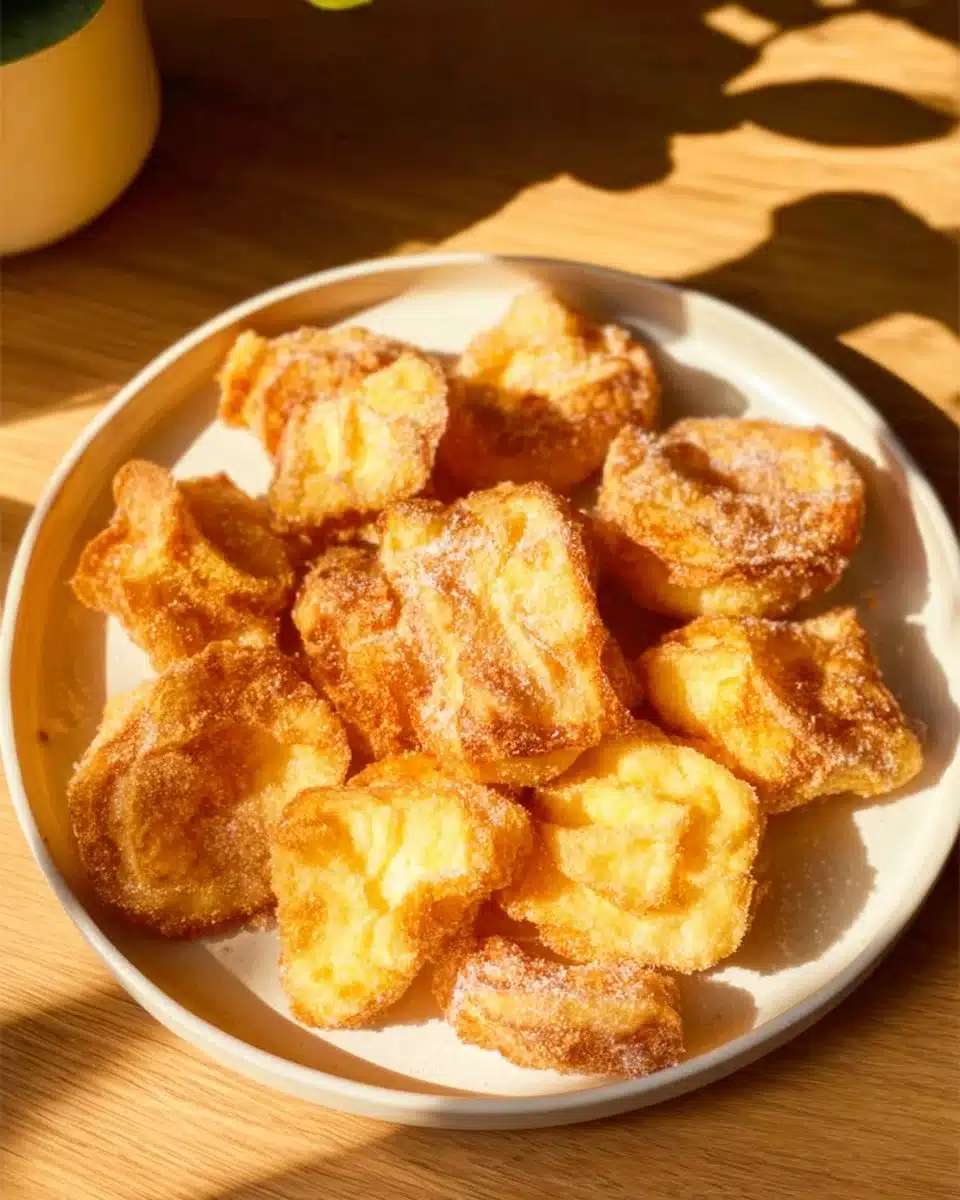
Fried Milk: Crispy Spanish Custard Recipe
Browned sugar, crackling breadcrumbs, and a spoonful of molten custard — fried milk delivers all of that in one bite. This version of the classic Spanish treat, often called leche frita, makes a silky milk custard that sets firm enough to slice, then gets a golden, crunchy shell after a quick fry. After testing this recipe eight times with different starch ratios and resting times, I landed on a balance that gives a glossy, tender interior and a reliably crisp coating. I refined the technique during a menu-development stint at a small tapas bar, where speed and consistency mattered. The result is a dessert you can make at home with everyday ingredients and a few chef tricks. Read on for exact measurements, timing, and the pro tips that prevent the usual stumbles, like a runny center or a soggy crust.
Why This Recipe Works
- Thickening with a mix of cornstarch and a little all-purpose flour gives a smooth, stable custard that sets without becoming gummy.
- Cooking the custard slowly over medium heat prevents lumps and creates a glossy mouthfeel.
- Chilling the custard thoroughly firms it enough for clean slicing and minimizes oil absorption during frying.
- A three-stage breading (flour → egg → fine breadcrumbs) creates a durable crust that stays crisp.
- Frying at a steady 180°C (350°F) ensures quick browning without overcooking the custard inside.
Ingredients Breakdown
- Whole milk — 800 ml (3 1/3 cups): The base flavor. Whole milk gives richness and silkiness. Skim will make the custard thin and less satisfying.
- Granulated sugar — 150 g (3/4 cup): Sweetens and helps caramelize the surface slightly during frying.
- Cornstarch — 90 g (3/4 cup): Main thickener for a clean, glossy set. Do not replace entirely with flour or results will be pasty.
- All-purpose flour — 40 g (1/3 cup): Adds structure and helps the custard hold shape; combined with cornstarch it yields a smooth texture.
- Unsalted butter — 30 g (2 tbsp): Adds silk and flavor. Use salted butter? Reduce added salt by half.
- Egg yolks — 3 large: Enrich the custard and help with creaminess.
- Lemon zest — 1 tsp finely grated: Brightens the milk base. Can substitute orange zest for a different profile.
- Ground cinnamon — 1/2 tsp: Classic warming note in leche frita.
- Fine salt — 1/4 tsp: Balances sweetness.
- All-purpose flour for dredging — 60 g (1/2 cup): Light dusting before egg wash. For gluten-free option see Variations.
- Eggs for dredging — 2 large, beaten: Binds breadcrumbs to the squares.
- Fine dry breadcrumbs — 150 g (1 1/2 cups): Panko works but gives a coarser crust; choose fine breadcrumbs for a uniform exterior.
- Vegetable oil for frying — neutral oil (sunflower, canola): Enough for 4–6 cm (1.5–2.5 in) shallow frying or 1.5 L (6 cups) for deep-frying. Use fresh oil for best flavor.
Substitutions with impact warnings:
- Milk swap: Use 2% for slightly less richness — texture will be lighter.
- Cornstarch alternative: Potato starch can work, but it sets more fragilely; handle chilled pieces carefully.
- Breadcrumbs swap: Panko will be crunchier but may brown faster; monitor color and oil temperature.
Essential Equipment
- Medium heavy-bottomed saucepan (2–3 L): Promotes even heating while cooking custard.
- Whisk and heatproof spatula: For constant stirring.
- Fine-mesh sieve: To strain custard and remove any possible lumps.
- Rectangular or square 20 x 20 cm (8 x 8 in) pan, lined: Allows even cooling and easy slicing.
- Thermometer (candied or infrared): For checking oil at 180°C (350°F). A probe thermometer helps with custard temperature checks.
- Frying pan (for shallow frying) or deep pot (for deep-frying): If you don’t have a deep fryer, use a heavy pot with at least 12 cm (5 in) sides to limit splatter.
- Cooling rack and sheet pan: Drains excess oil and keeps crust crisp.
- Kitchen scale (preferred): Weighing ingredients yields more consistent results.
If you don’t have a square pan, any shallow container that is 2–3 cm (3/4–1 in) deep will work — just adjust chilling time if the custard layer is thicker.
Prep Time: 20 minutes, Cook Time: 15 minutes active, Inactive Time: 4 hours chill, Total Time: 4 hours 35 minutes, Servings: 6 (1 square each)
Step 1: Warm the Milk and Infuse Flavor
Pour 800 ml (3 1/3 cups) whole milk into a saucepan with 1 tsp lemon zest and 1/2 tsp ground cinnamon. Warm over medium heat until it steam-simmers and you see wisps of steam, about 4–5 minutes; do not boil. Remove from heat and let steep for 10 minutes, covered.
Step 2: Mix Dry Ingredients and Eggs
In a bowl, whisk together 90 g (3/4 cup) cornstarch, 40 g (1/3 cup) all-purpose flour, 150 g (3/4 cup) granulated sugar, and 1/4 tsp fine salt. In a separate bowl, whisk 3 large egg yolks until smooth. Reserve.
Step 3: Temper and Combine
Return the infused milk to gentle heat. Ladle about 120 ml (1/2 cup) hot milk into the yolks while whisking vigorously, then pour the yolk mix back into the pan. Add the dry mix gradually, whisking constantly to avoid lumps. Cook over medium-low, whisking constantly, until the mixture thickens and pulls away slightly from the pan, about 6–8 minutes. You want a thick custard that coats the back of a spoon.
Step 4: Finish the Custard
Off the heat, whisk in 30 g (2 tbsp) unsalted butter until melted and glossy. Strain the custard through a fine-mesh sieve into a lined 20 x 20 cm (8 x 8 in) pan, smoothing the top. Press plastic wrap directly onto the surface to prevent a skin. Chill in the refrigerator for at least 4 hours or overnight until firm.
Step 5: Slice and Prepare Coatings
Turn the chilled custard onto a cutting board and cut into 6 even squares (about 6 cm / 2 1/2 in each). Set up your dredging station: shallow bowl with 60 g (1/2 cup) flour, bowl with 2 beaten large eggs (about 100 ml / 3.5 fl oz), and a plate with 150 g (1 1/2 cups) fine breadcrumbs. Dredge each square in flour, tap off excess, dip in beaten egg, then press into breadcrumbs to coat fully. Rest coated squares on a tray for 10 minutes to set the crust.
Step 6: Fry to Golden
Heat oil to 180°C (350°F). If shallow frying, use 4–6 cm (1.5–2.5 in) of oil in a wide skillet. Fry 2–3 pieces at a time for 2–3 minutes per side, until deeply golden and crisp. Use a slotted spoon to transfer to a wire rack over a sheet pan to drain. Internal doneness cue: custard should be warm but not bubbling; the center will still be soft but not runny.
Step 7: Serve Warm
Serve each square warm with a dusting of powdered sugar or a sprinkle of ground cinnamon. For a contrast, offer a small scoop of vanilla ice cream or a drizzle of honey. Enjoy immediately for best texture.
Expert Tips & Pro Techniques
- Chill thoroughly: Do not rush the chill — the custard must be cold and firm for clean cutting and minimal oil absorption.
- Constant whisking prevents lumps: Stir in a figure-eight motion and scrape the pan bottom so nothing sticks and scorches.
- Use a fine sieve: Straining the custard before chilling removes any cooked bits and guarantees a silky interior.
- Breadcrumb choice: Fine panko gives extra crunch but may brown faster; reduce frying time by 30 seconds per side if using panko.
- Common mistake — soggy crust: This happens when oil is too cool or custard too warm. Keep oil at 180°C (350°F) and pieces cold.
- Make-ahead: The custard can be set and breaded up to 24 hours ahead; keep breaded pieces in the fridge on a tray covered loosely with plastic until frying.
- Professional trick adapted for home: Add 1 tbsp neutral oil to the crumbs and pulse briefly in a food processor for an even, clingy crumb that browns evenly.
- Oil management: Change oil after several batches if it darkens; burnt crumbs will taint flavor.
Storage & Reheating
- Refrigerator: Store leftover unfried custard squares or fried pieces in an airtight container for up to 3 days. Place paper towel under fried pieces to absorb steam.
- Freezer: The uncooked custard (before breading) freezes well. Wrap tightly and freeze for up to 2 months. Thaw overnight in the refrigerator, then bread and fry as directed. Fried pieces do not freeze well — crust becomes soggy on thawing.
- Reheating: Reheat fried pieces in a 175°C (350°F) oven for 6–8 minutes to refresh the crust. Avoid microwaving, which makes the crust soggy and the custard rubbery.
Variations & Substitutions
- Gluten-Free Version: Replace both the all-purpose flours used in the custard and for dredging with a 1:1 gluten-free blend and use 1/2 tsp xanthan gum if your blend lacks it. Frying time remains the same.
- Lighter Version: Swap 400 ml (1 2/3 cups) whole milk + 400 ml (1 2/3 cups) 2% milk to cut some fat. Texture will be slightly less rich; reduce cornstarch to 80 g (2/3 cup) to keep creaminess.
- Citrus Twist: Substitute orange zest for lemon and add 1 tbsp orange liqueur (optional) to the warm custard before chilling for a bright flavor. Alcohol will evaporate during frying.
- Chocolate-Covered: Stir 30 g (1 oz) melted dark chocolate into the warm custard before setting for a chocolate milk custard. Chocolate will slightly firm the custard; guard against over-thickening by reducing cornstarch by 10 g (1 tbsp).
Serving Suggestions & Pairings
- Serve with a small scoop of vanilla or cinnamon ice cream for a hot-cold contrast.
- Pair with strong espresso or a short macchiato to cut the sweetness.
- Garnish with a dusting of powdered sugar and a thin lemon or orange slice for brightness.
- For a tapas-style finish, present small pieces alongside fresh fruit and a drizzle of honey.
- Pair with our roasted fruit compote for a seasonal twist.
Nutrition Information
Per serving (1 square). Servings: 6. Serving size: about 1 piece (approx. 90–110 g).
- Calories: ~530 kcal
- Total Fat: ~28 g
- Saturated Fat: ~11 g
- Cholesterol: ~125 mg
- Sodium: ~180 mg
- Total Carbohydrates: ~63 g
- Dietary Fiber: ~1 g
- Sugars: ~30 g
- Protein: ~7 g
Nutrition values are estimates. Actual values may vary based on specific ingredients and preparation methods.
Frequently Asked Questions
Q: Why did my custard turn out grainy?
A: Graininess usually means the starch cooked too fast or the mixture wasn’t whisked smoothly. Strain the custard and next time whisk constantly and cook over medium-low heat until glossy.
Q: Can I make this without eggs?
A: You can omit the egg yolks, but the custard will be less rich and may require an increase in cornstarch by 15–20 g (2–3 tbsp) for structure. The dredging egg is essential for breadcrumbs to stick; use a plant-based egg replacer if avoiding eggs entirely.
Q: Can I double this recipe?
A: Yes. Double all ingredients and use a wider pan so the custard layer stays about 2–3 cm (3/4–1 in) thick. Chill time may increase by 1–2 hours due to greater volume.
Q: Can I prepare this the night before?
A: Absolutely. You can make the custard and chill it overnight. For best texture, bread the pieces the same day you plan to fry them or bread the night before and keep them chilled on a tray.
Q: How long does this keep in the fridge?
A: Unfried custard keeps 3–4 days in the refrigerator. Fried pieces are best eaten the same day but can be stored up to 2 days; re-crisp in a hot oven before serving.
Q: My crust fell off during frying. What went wrong?
A: Common causes are insufficient chilling, wet or thick coating, or oil temperature too high. Make sure pieces are well chilled and that you use a thin, even breading — tap off excess flour before egg, and press crumbs gently but firmly. Keep oil at 180°C (350°F).
Q: Can I shallow-fry instead of deep-frying?
A: Yes. Use 4–6 cm (1.5–2.5 in) oil in a wide skillet and flip after 2–3 minutes. Ensure the oil returns to temperature between batches for even browning.
Conclusion
If you want to compare regional takes or follow a tested step-by-step visual guide, this Spanish Leche Frita dessert recipe on The Spruce Eats is a helpful reference. For historical context and name variations, see the overview of leche frita on Wikipedia.
Print
Fried Milk: Crispy Spanish Custard
- Total Time: 275 minutes
- Yield: 6 servings 1x
- Diet: Vegetarian
Description
This Spanish Leche Frita features a silky milk custard with a crispy exterior, delivering delightful textures and flavors in every bite.
Ingredients
- 800 ml (3 1/3 cups) whole milk
- 150 g (3/4 cup) granulated sugar
- 90 g (3/4 cup) cornstarch
- 40 g (1/3 cup) all-purpose flour
- 30 g (2 tbsp) unsalted butter
- 3 large egg yolks
- 1 tsp lemon zest
- 1/2 tsp ground cinnamon
- 1/4 tsp fine salt
- 60 g (1/2 cup) all-purpose flour for dredging
- 2 large eggs, beaten
- 150 g (1 1/2 cups) fine dry breadcrumbs
- Vegetable oil for frying
Instructions
- Warm the milk with lemon zest and cinnamon over medium heat until steaming, then let steep.
- Mix the cornstarch, flour, sugar, and salt in one bowl, and whisk egg yolks separately in another.
- Temper by combining hot milk with egg yolks, then add dry mixture gradually while whisking.
- Finish the custard by incorporating butter, then strain into a lined pan and chill.
- Slice the chilled custard into squares and prepare the dredging station.
- Fry the coated custard squares in hot oil until golden and crisp.
- Serve warm, dusted with powdered sugar or cinnamon, and enjoy.
Notes
Chill the custard thoroughly to ensure clean slicing. Keep oil at 180°C (350°F) for optimal frying results.
- Prep Time: 20 minutes
- Cook Time: 15 minutes
- Category: Dessert
- Method: Frying
- Cuisine: Spanish
Nutrition
- Serving Size: 1 serving
- Calories: 530
- Sugar: 30g
- Sodium: 180mg
- Fat: 28g
- Saturated Fat: 11g
- Unsaturated Fat: 13g
- Trans Fat: 0g
- Carbohydrates: 63g
- Fiber: 1g
- Protein: 7g
- Cholesterol: 125mg