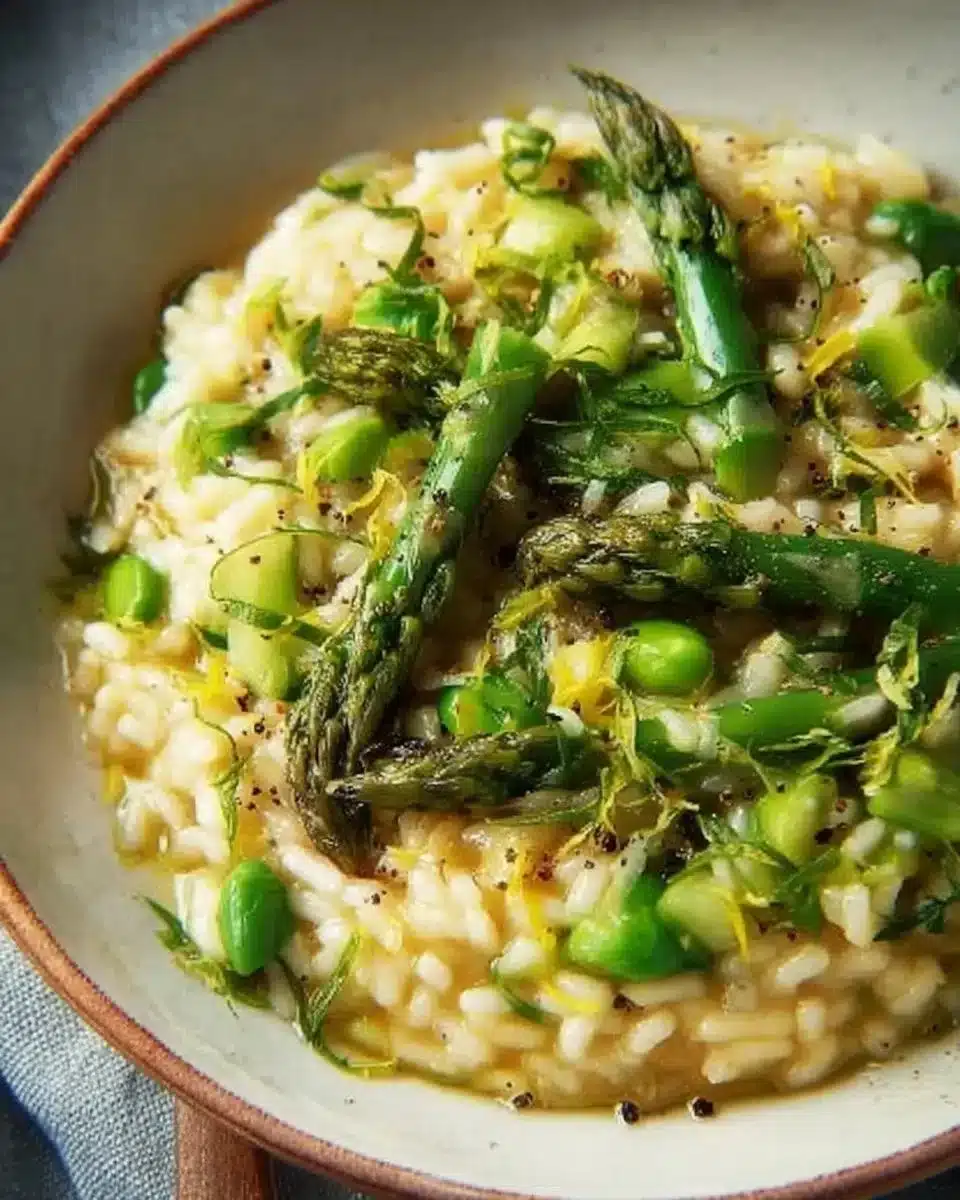
Creamy Spring Risotto with Tender Asparagus
Bright, silky, and full of lemony green flavor — this asparagus risotto sings of spring and comes together on a busy weeknight. I first developed this version while testing seasonal menus and have now refined it through eight home-kitchen trials to make it fast and foolproof. The technique borrows from classic Italian risotto: toast the rice, deglaze with wine, and add hot stock a ladle at a time until the grains are creamy and toothsome. This spring risotto keeps the asparagus vibrant by steaming the tips separately and folding them in at the end for color and crunch. Read on for exact timings, metric and imperial measures, and pro tips that stop common mistakes and yield a silky plate every time.
Why This Recipe Works
- Toasting the rice adds nutty depth and helps the grains hold their shape during slow cooking.
- Adding hot stock in small ladles encourages starch release for a naturally creamy texture — no cream needed.
- Cooking asparagus tips briefly preserves bright color and snap, while the stems flavor the base.
- Acid (lemon) and Parmigiano-Reggiano balance the richness and brighten the final dish.
- Stirring rhythm (frequent, not frantic) prevents sticking and promotes even cooking.
Ingredients Breakdown
- Arborio rice 320 g (1 2/3 cups): Short-grain rice high in starch. It creates the risotto’s classic creaminess. Do not use long-grain rice.
- Vegetable stock 1.0 L (4 cups), kept simmering: Hot liquid is crucial to maintain cooking temperature and release starch. Substitute low-sodium chicken stock for non-vegetarian versions.
- Dry white wine 120 ml (1/2 cup): Adds acidity and depth. You may omit and use extra stock, but the flavor will be flatter.
- Unsalted butter 30 g (2 tbsp) + extra 15 g (1 tbsp) for finishing: Use unsalted to control seasoning.
- Extra-virgin olive oil 15 ml (1 tbsp): For sautéing shallots.
- Shallot 1 large (about 70 g), finely chopped: Provides a gentle onion flavor. Yellow onion is OK — use 1/2 medium.
- Garlic 1 clove, minced: Small boost of savory flavor.
- Asparagus 350 g (12 oz): Reserve 120 g (4 oz) of tips for finishing; chop the remaining stems for cooking.
- Parmigiano-Reggiano 60 g (1/2 cup), finely grated: Adds umami and creaminess when stirred in. Use a good-quality parm.
- Lemon zest and juice: Zest of 1 lemon + 15 ml (1 tbsp) juice; brightens the dish.
- Kosher salt 1 tsp (use Diamond Crystal); if using Morton’s, use 1/2 tsp — Morton’s is denser.
- Freshly ground black pepper to taste.
- Optional: 60 g (1/2 cup) frozen peas — stir in with asparagus tips for a sweeter note.
Substitutions and impact warnings:
- Dairy-free: Replace butter and parm with 45 ml (3 tbsp) extra olive oil and 60 ml (1/4 cup) cashew cream; the result will be less umami and slightly looser.
- Gluten-free: Naturally gluten-free.
- Rice swap: Do not use arborio alternatives like sushi rice; carnaroli works well but adjust times.
Essential Equipment
- Heavy-bottomed sauté pan or wide saucepan (about 3–4 L / 3–4 qt): A wide pan evaporates better and helps even cooking.
- Small saucepan for stock: Keep stock simmering nearby.
- Heatproof ladle or measuring cup: For adding hot stock in consistent amounts.
- Sharp knife and cutting board: For trimming asparagus.
- Microplane or fine zester: For lemon zest.
- Wooden spoon or flexible spatula: For stirring — metal spoons can be too aggressive.
- Instant-read thermometer (optional): Not required, but handy to check hot stock temperature (~90–95°C / 195–205°F).
If you don’t have a wide pan, use a deep skillet; just stir a bit more often to avoid cold spots.
Time: Prep 15 minutes · Cook 25 minutes · Inactive time None · Total 40 minutes · Serves 4
Step 1: Prep the asparagus and stock
Bring 1.0 L (4 cups) vegetable stock to a simmer in a small saucepan and keep hot at a gentle simmer (90–95°C / 195–205°F). Trim 350 g (12 oz) asparagus: cut off woody ends, save the top 120 g (4 oz) of tips whole, and slice the remaining stems into 1 cm (½ inch) pieces. Blanch the tips in simmering water 1 minute, then plunge into ice water to stop cooking; drain and set aside.
Step 2: Sweat the aromatics
Heat 15 ml (1 tbsp) olive oil + 30 g (2 tbsp) unsalted butter in a wide pan over medium heat (around 150–160°C / 300–325°F). Add 1 chopped shallot and sauté until translucent and fragrant, about 3–4 minutes, stirring every 30 seconds. Add 1 minced garlic clove and cook 30 seconds until fragrant.
Step 3: Toast the rice and deglaze
Add 320 g (1 2/3 cups) arborio rice and cook, stirring, for 2 minutes until edges look translucent and the grains smell nutty. Pour in 120 ml (1/2 cup) dry white wine and cook, stirring, until the wine is nearly evaporated, about 2–3 minutes.
Step 4: Cook the risotto with hot stock
Begin adding hot stock by ladlefuls — about 120 ml (1/2 cup) at a time. After each addition, stir frequently (every 20–30 seconds) until most liquid is absorbed, about 2–3 minutes per ladle. Continue this process for 16–18 minutes total, testing for doneness: the grains should be tender on the outside with a slight bite in the center. Do not add all the stock at once — this prevents a creamy texture.
Step 5: Fold in asparagus and finish
When rice is nearly done (after 16–18 minutes), stir in the chopped asparagus stems and 60 g (1/2 cup) frozen peas if using; cook 1–2 minutes until stems are tender. Remove from heat and stir in 60 g (1/2 cup) finely grated Parmigiano-Reggiano, 15 g (1 tbsp) unsalted butter, lemon zest of 1 lemon, and 15 ml (1 tbsp) lemon juice. Season with 1 tsp kosher salt (Diamond Crystal) and freshly ground black pepper. Gently fold in the blanched asparagus tips. Let rest 1–2 minutes — the risotto will loosen as it rests.
Step 6: Serve immediately
Spoon into warmed bowls and finish with an extra sprinkle of Parmigiano and a drizzle of olive oil. Risotto is best the moment it’s plated; serve hot and creamy. Total active cook time after prep: about 25 minutes.
Expert Tips & Pro Techniques
- Common mistake: adding cold stock chills the pan and slows cooking. Keep the stock simmering so each ladle maintains temperature.
- Don’t stop stirring for long stretches; gentle frequent stirring encourages starch release for a creamy finish.
- Pro trick adapted for home cooks: use a wide pan rather than a deep pot — it increases surface area and shortens cooking time while making stirring easier.
- Make-ahead: cook the risotto until it’s slightly underdone (about 2 minutes shy). Cool quickly, spread in a shallow container, and refrigerate up to 24 hours. To reheat, add 60–120 ml (1/4–1/2 cup) hot stock per serving and stir over medium heat until loose and creamy.
- Texture control: if the risotto is too thick, add a few tablespoons of hot stock or water and stir until silky.
- Flavor boost: finish with a small knob of cold butter (15 g / 1 tbsp) and a generous grating of parm right before serving for glossy sheen and rounded flavor.
Storage & Reheating
- Refrigerator: Store cooled risotto in an airtight container for up to 3 days. Press a piece of plastic wrap directly onto the surface to prevent a skin from forming.
- Freezer: Risotto generally loses texture when frozen. If you must freeze, cool completely, pack in freezer-safe containers, and freeze up to 1 month. Thaw overnight in the refrigerator before reheating.
- Reheating: Reheat on the stovetop over medium-low with 60–120 ml (1/4–1/2 cup) hot stock or water per serving, stirring until just creamy. You can reheat in a 175°C (350°F) oven in a covered dish for 10–12 minutes after adding extra liquid. Avoid microwaving when possible — it can make the texture gummy.
Variations & Substitutions
- Pea & Asparagus Risotto: Add 60 g (1/2 cup) frozen peas with the asparagus stems. Keep quantities the same; no time change.
- Dairy-Free Version: Replace butter with 45 ml (3 tbsp) olive oil and parm with 60 ml (1/4 cup) cashew cream or nutritional yeast. The texture will be slightly less silky; add extra lemon to brighten.
- Protein Add-In: Sear 340 g (12 oz) shrimp (2–3 minutes per side) in a separate pan with salt and lemon, then fold into finished risotto. Cook shrimp separately to avoid overcooking rice.
- Lemon-Thyme: Add 1 tsp fresh thyme leaves with the shallots and increase lemon zest to 1 1/2 lemons for a herbier note.
- Richer Finish: Stir in 60 ml (1/4 cup) heavy cream at the end for an extra-luxurious, creamier risotto; the dish will be richer but less traditional.
Serving Suggestions & Pairings
- Light salad: Arugula tossed with lemon vinaigrette and shaved Parm — a bright counterpoint. [Pair with our Garlic Roasted Potatoes].
- Simple protein: Roast a lemon-thyme chicken or pan-sear skate; both match the risotto’s delicate flavors.
- Wine pairing: A crisp Pinot Grigio or Vermentino complements the lemon and asparagus notes.
- Garnish: Finish with extra lemon zest, toasted breadcrumbs for crunch, or a few drops of high-quality olive oil.
Nutrition Information
Per serving (Serving size: about 1 cup; recipe makes 4 servings)
- Calories: 420 kcal
- Total Fat: 13 g
- Saturated Fat: 6 g
- Cholesterol: 25 mg
- Sodium: 560 mg
- Total Carbohydrates: 62 g
- Dietary Fiber: 3 g
- Sugars: 4 g
- Protein: 11 g
Nutrition values are estimates. Actual values may vary based on specific ingredients and preparation methods.
Frequently Asked Questions
Q: Why did my risotto turn out gluey or gummy?
A: Most often this happens from over-stirring or using too much liquid at once. Stir gently and add stock gradually. Also, cook at a steady simmer rather than a full boil.
Q: Can I make this without cheese?
A: Yes. Omit Parmigiano-Reggiano and finish with extra lemon zest and a drizzle of olive oil. For a cheesy feel, stir in 60 ml (1/4 cup) cashew cream or 2 tbsp nutritional yeast.
Q: Can I double this recipe for a dinner party?
A: Yes, but use a very large, wide pan to keep even heat distribution. You may need to increase total cook time by 3–5 minutes. Stirring rhythm remains the same.
Q: Can I prepare risotto the night before?
A: You can cook it until slightly underdone, cool quickly, and refrigerate overnight. Reheat with 60–120 ml (1/4–1/2 cup) hot stock per serving and stir until creamy.
Q: How long does leftover risotto keep in the fridge?
A: Store in an airtight container for up to 3 days. Reheat on the stovetop with a splash of hot stock.
Q: Why are my asparagus tips mushy?
A: Overcooking. Blanch tips only 1 minute, then shock in ice water. Reserve them to fold in at the end so they stay bright and slightly crisp.
Q: Is risotto naturally gluten-free?
A: Yes, arborio rice and the ingredients here are gluten-free. Check your stock and any added ingredients to ensure they are certified gluten-free if needed.
Conclusion
This asparagus risotto is designed for busy home cooks who want a special meal with minimal fuss. For a vegetable-forward take and a slightly different technique, see Lemons & Zest’s Creamy Pea and Asparagus Risotto. For another spring-focused riff with roasted garlic cashew cream, try Blissful Basil’s Spring Risotto with Asparagus and Peas.
Enjoy this risotto hot, and remember the simple rules: hot stock, patient ladles, and a bright finish.
Print
Creamy Spring Risotto with Tender Asparagus
- Total Time: 40 minutes
- Yield: 4 servings 1x
- Diet: Vegetarian
Description
Bright, silky, and full of lemony green flavor, this asparagus risotto is easy to prepare and brings a taste of spring to your table.
Ingredients
- 320 g (1 2/3 cups) Arborio rice
- 1.0 L (4 cups) vegetable stock, kept simmering
- 120 ml (1/2 cup) dry white wine
- 30 g (2 tbsp) unsalted butter
- 15 g (1 tbsp) unsalted butter for finishing
- 15 ml (1 tbsp) extra-virgin olive oil
- 1 large shallot, finely chopped (about 70 g)
- 1 clove garlic, minced
- 350 g (12 oz) asparagus
- 60 g (1/2 cup) Parmigiano-Reggiano, finely grated
- Zest of 1 lemon + 15 ml (1 tbsp) lemon juice
- 1 tsp kosher salt
- Freshly ground black pepper to taste
- Optional: 60 g (1/2 cup) frozen peas
Instructions
- Prep the asparagus and stock: Bring 1.0 L (4 cups) vegetable stock to a simmer in a small saucepan and keep hot. Trim 350 g (12 oz) asparagus, save the top 120 g (4 oz) of tips whole, and slice the remaining stems into 1 cm (½ inch) pieces. Blanch the tips for 1 minute, then plunge in ice water; drain and set aside.
- Heat 15 ml (1 tbsp) olive oil and 30 g (2 tbsp) unsalted butter in a wide pan over medium heat. Add shallot and sauté until translucent, about 3-4 minutes. Add garlic and cook for 30 seconds.
- Add 320 g (1 2/3 cups) Arborio rice and cook for 2 minutes until edges look translucent. Pour in 120 ml (1/2 cup) dry white wine and cook until nearly evaporated, about 2-3 minutes.
- Begin adding hot stock by ladlefuls, about 120 ml (1/2 cup) at a time, stirring frequently for 16-18 minutes until grains are tender with a slight bite.
- Stir in chopped asparagus stems and peas (if using); cook for 1-2 minutes until tender. Remove from heat and stir in Parmigiano-Reggiano, remaining butter, lemon zest, and lemon juice. Season with salt and pepper, and fold in asparagus tips.
- Serve immediately in warmed bowls, adding more Parmigiano and a drizzle of olive oil to finish.
Notes
Ensure to keep the stock hot for best results. For a dairy-free version, substitute with olive oil and cashew cream.
- Prep Time: 15 minutes
- Cook Time: 25 minutes
- Category: Main Course
- Method: Stovetop
- Cuisine: Italian
Nutrition
- Serving Size: 1 serving
- Calories: 420
- Sugar: 4g
- Sodium: 560mg
- Fat: 13g
- Saturated Fat: 6g
- Unsaturated Fat: 7g
- Trans Fat: 0g
- Carbohydrates: 62g
- Fiber: 3g
- Protein: 11g
- Cholesterol: 25mg