Crisp, Thin Shoestring French Fries
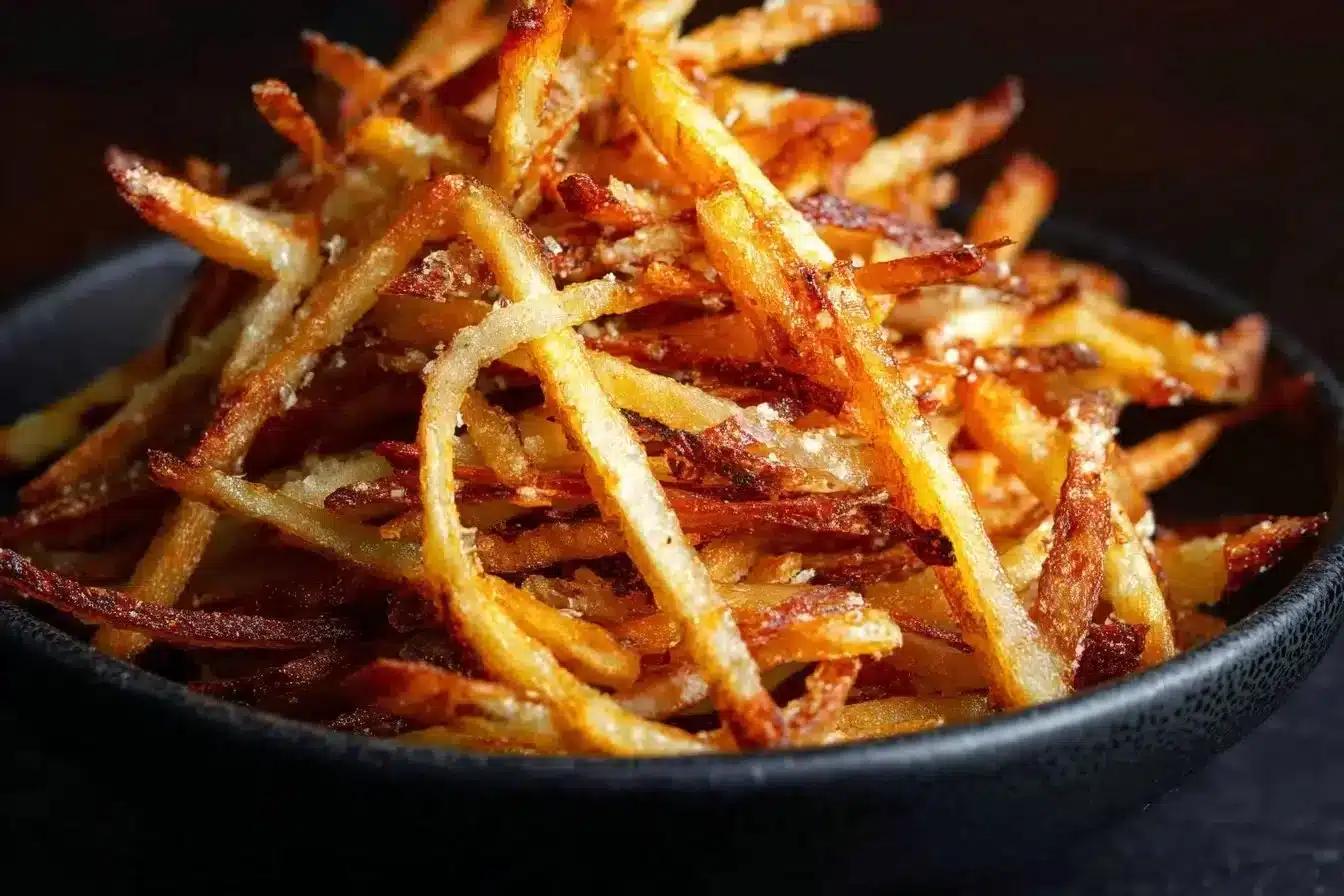
They snap and sing when you bite them, with a light, golden crunch and a soft, steaming center. Homemade Shoestring French Fries deliver that exact contrast when you cut the potatoes very thin, remove surface starch, and use a two-stage frying method. I developed this version while testing at home and in a small bistro kitchen, and I refined it through nine full trials to get the timing and technique right. This recipe focuses on precise cuts, a short soak to remove excess starch, and a blast of high heat for final crisping. Read on for clear, metric-and-imperial measurements, professional tips adapted for home cooks, and quick troubleshooting so your fries come out perfect every time.
Why This Recipe Works
- Very thin cuts increase surface area so fries crisp up faster and stay light.
- Soaking removes surface starch so fries don’t clump and become gummy.
- Two-stage frying (low then high heat) cooks the interior without burning the exterior.
- A light dusting of cornstarch helps create an extra-crisp crust without changing flavor.
- Resting fries briefly on a wire rack keeps air moving around them so they stay crisp.
Ingredients Breakdown
- Russet potatoes — 900 g (2.0 lb), about 3 large: High-starch potatoes fry crispest. Avoid waxy potatoes; they stay dense.
- Cold water — for soaking: Draws out surface starch to keep fries separate and crisp.
- White vinegar — 15 ml (1 tbsp): Optional in soak; helps keep color and assists crisping.
- Cornstarch — 10 g (2 tsp): Light coating improves crunch. Skip it if you prefer no coating.
- Vegetable oil (peanut, canola, or sunflower) — enough for deep frying (about 1.5 L / 6 cups): Use a neutral oil with a smoke point above 190°C (375°F). Peanut oil gives a slightly nutty flavor.
- Kosher salt — 10 g (2 tsp) or to taste: Use Diamond Crystal if available. If using Morton’s kosher salt, use half the amount (it’s denser).
- Optional: finely grated Parmesan, smoked paprika, or chopped parsley for finishing.
Substitutions with impact warnings:
- Sweet potatoes: Use the same method, but they brown faster. Fry at slightly lower final temp and watch closely.
- Air-fryer: You can air-fry shoestring cuts, but they will be less uniformly crisp. Toss lightly in oil and cook in a single layer.
- Cornstarch alternative: Rice flour can be used, but the crust will be slightly grainier.
Essential Equipment
- Mandoline with a julienne blade or a julienne peeler: Fastest way to get uniform shoestring cuts. Alternative: a very sharp chef’s knife and patience.
- Large bowl and a second bowl with ice water: For soaking and chilling.
- Heavy-bottomed pot or Dutch oven (5–6 L / 5–6 qt) or a deep fryer: Depth should allow 8–10 cm (3–4 in) of oil.
- Candy/deep-fry thermometer: Keeps oil at precise temps (160°C / 320°F and 190°C / 375°F).
- Spider/skimmer and metal tongs: For safe handling.
- Wire rack set over a rimmed baking sheet: Prevents soggy bottoms during resting.
- Paper towels (for quick blotting) and a large sieve or colander.
Step-by-Step Instructions
Prep time 20 minutes; Cook time 15 minutes active; Inactive time None; Total time 35 minutes. Serves 4 (about 1 cup / 120 g per serving).
Step 1: Trim and cut the potatoes
Peel (optional) and trim 900 g (2.0 lb) russet potatoes. Using a mandoline with a julienne blade or a julienne peeler, cut into 3 mm (1/8 in) thin sticks—uniform thickness matters for even cooking. If using a knife, stack thin planks and slice into matchsticks.
Step 2: Rinse and soak to remove starch
Place the cut potatoes in a large bowl of cold water and swish until the water runs cloudy, about 30 seconds. Add 15 ml (1 tbsp) white vinegar if using, then drain and refill with fresh cold water. Soak for 10–15 minutes until water stays clearer and fries feel less sticky.
Step 3: Dry thoroughly
Drain the potatoes in a colander and spread them on clean kitchen towels or paper towels. Pat completely dry, about 2–3 minutes per batch—wet fries cause oil to spit and will steam instead of crisp. Let them rest on a wire rack for 5 minutes to air-dry further.
Step 4: Toss with cornstarch and season lightly
Place the dried sticks in a large bowl and sprinkle 10 g (2 tsp) cornstarch evenly, tossing to coat. The coating should be barely visible. Season lightly with 3 g (1/2 tsp) kosher salt now; final seasoning will be adjusted after frying.
Step 5: Heat oil and first fry (blanch)
Heat oil in a heavy pot to 160°C (320°F). Fry the potatoes in small batches for 3 minutes, stirring gently every 30 seconds, until they are cooked through but pale and flexible. Remove with a skimmer and drain on a wire rack. Let cool for 5–7 minutes. Do not overcrowd the pot—crowding drops the oil temp and produces soggy fries.
Step 6: Second fry for color and crisp
Raise the oil temperature to 190°C (375°F). Fry the cooled potatoes in batches for 1–2 minutes, or until golden brown and crisp. Remove to a clean wire rack, season immediately with kosher salt, and let rest 1 minute before serving. Serve hot for best texture.
Expert Tips & Pro Techniques
- Common mistake: overcrowding the oil. Always fry in small batches so the oil temperature stays stable. Use a thermometer to monitor.
- Knife vs. mandoline: A mandoline yields consistent 3 mm (1/8 in) sticks. If you must hand-cut, stack and slice thin planks and then julienne to match thickness.
- Oil temperature control: For safety and crispness, maintain 160°C (320°F) for blanching and 190°C (375°F) for finishing. Adjust burner heat 15–20% as needed.
- Make-ahead: Blanch and cool fries, then freeze them spread on a rimmed sheet for 1 hour. Transfer frozen fries to a bag and store up to 1 month. Finish-fry from frozen at 190°C (375°F) for 2–3 minutes.
- Pro technique adapted for home: Dusting with cornstarch creates a micro-crust. Use just 2 tsp per 900 g to avoid a gummy coating.
- Flavor finish: Toss fries hot with grated Parmesan and a pinch of smoked paprika for a quick flavor boost.
Storage & Reheating
- Refrigerator: Store cooled fries in an airtight container or paper-towel–lined container for up to 2 days. Crispness will degrade.
- Freezer: Blanched (but not fully fried) shoestrings freeze best. Flash-freeze blanched fries on a tray for 1 hour, then transfer to a freezer bag for up to 1 month. Fully fried fries freeze ok but lose crispness faster.
- Reheating: Re-crisp in a 175°C (350°F) oven on a wire rack for 6–8 minutes, or re-fry at 190°C (375°F) for 1–2 minutes. Avoid microwaving—microwaves make fries soggy.
Variations & Substitutions
- Garlic-Parmesan Shoestrings: After frying, toss 900 g (2.0 lb) fries with 15 g (1 tbsp) finely grated Parmesan and 1 clove minced garlic sautéed until fragrant. Serve immediately.
- Sweet Potato Shoestrings: Use 900 g (2.0 lb) thinly cut sweet potatoes. Soak for 5–10 minutes; reduce final fry time by 30–60 seconds to prevent over-browning.
- Gluten-Free: The base recipe is naturally gluten-free. If you usually add cornstarch, ensure it’s certified gluten-free.
- Air-Fryer Option: Toss the shoestrings with 10–15 ml (2–3 tsp) oil and cook at 200°C (400°F) for 8–12 minutes, shaking every 3 minutes. Expect slightly less uniform crispness.
Serving Suggestions & Pairings
- Classic dip: Serve with ketchup, homemade aioli, or malt vinegar.
- Sandwich side: Pairs well with burgers, fish sandwiches, or a grilled cheese.
- Shared plates: Offer alongside fried chicken or a hearty steak to complement textures.
- Beverage pairing: Try a cold lager, a crisp dry cider, or a citrusy iced tea.
- Pair with our Garlic Roasted Potatoes for a different potato texture and flavor contrast.
Nutrition Information
Per serving (serving size: about 1 cup / 120 g). Makes 4 servings.
- Calories: 330 kcal
- Total Fat: 14 g
- Saturated Fat: 2 g
- Cholesterol: 0 mg
- Sodium: 390 mg
- Total Carbohydrates: 47 g
- Dietary Fiber: 4 g
- Sugars: 1 g
- Protein: 4 g
Nutrition values are estimates. Actual values may vary based on specific ingredients and preparation methods.
Frequently Asked Questions
Q: Why did my shoestring fries turn out soggy?
A: The most common cause is excess moisture or overcrowding the oil. Dry the cuts completely and fry in small batches so the oil temp stays high.
Q: Can I make these without cornstarch?
A: Yes. Cornstarch grabs moisture and crisps the surface. Omitting it makes a lighter crust but may reduce final crunch slightly.
Q: Can I double this recipe for a crowd?
A: Yes. Work in multiple batches and keep fried batches warm in a 95°C (200°F) oven on a wire rack. Do not double in one pot or you’ll lower the oil temperature.
Q: Can I prepare the fries the night before?
A: You can cut and soak the potatoes the night before, then dry and refrigerate them for up to 24 hours on a rack. For best results, finish frying the same day or blanch now and finish-fry later.
Q: How long do cooked fries keep in the fridge?
A: Store in an airtight container for up to 2 days. They’ll lose crispness but can be reheated to revive texture.
Q: Why are my fries unevenly colored?
A: Uneven thickness or oil temperature variance cause color differences. Aim for uniform 3 mm (1/8 in) cuts and consistent oil temp of 190°C (375°F) for the second fry.
Q: Is two-stage frying necessary for shoestring fries?
A: Two-stage frying ensures the interior cooks through during the first, lower-temperature fry and the exterior crisps quickly during the high-temp finish. It’s the best way to get a light interior and crisp exterior.
Conclusion
These shoestring fries are a simple, high-reward recipe for anyone who loves a very thin, ultra-crisp fry. For a super-quick alternative with a similar result, try the 3-Ingredient Shoestring Fries Recipe at The Cookie Rookie for a pared-down method. For a deeper read on technique and the science behind thin fries, see the Shoestring French Fry Recipe and method guide at Serious Eats.
Author: Alex Martin — Culinary school graduate and recipe developer with 15 years in professional kitchens.
Print
Crisp, Thin Shoestring French Fries
- Total Time: 35 minutes
- Yield: 4 servings 1x
- Diet: Vegetarian
Description
Homemade Shoestring French Fries that deliver a light, golden crunch with a soft center, utilizing a two-stage frying method for the perfect contrast.
Ingredients
- 900 g (2.0 lb) russet potatoes, about 3 large
- Cold water, for soaking
- 15 ml (1 tbsp) white vinegar, optional
- 10 g (2 tsp) cornstarch
- Vegetable oil (peanut, canola, or sunflower), enough for deep frying (about 1.5 L / 6 cups)
- 10 g (2 tsp) kosher salt, or to taste
- Optional: finely grated Parmesan, smoked paprika, or chopped parsley for finishing
Instructions
- Trim and cut the potatoes: Peel (optional) and cut the russet potatoes into uniform 3 mm (1/8 in) thin sticks.
- Rinse and soak to remove starch: Soak the cut potatoes in a bowl of cold water for 10-15 minutes.
- Dry thoroughly: Drain and spread the potatoes on towels, patting dry for about 2-3 minutes per batch.
- Toss with cornstarch and season lightly: Coat the dried sticks with cornstarch and season with kosher salt.
- Heat oil and first fry (blanch): Fry potatoes in hot oil at 160°C (320°F) for 3 minutes, then drain on a rack.
- Second fry for color and crisp: Fry in hot oil at 190°C (375°F) for 1-2 minutes until golden brown, season and serve.
Notes
Avoid overcrowding during frying to maintain oil temperature for crispy results.
- Prep Time: 20 minutes
- Cook Time: 15 minutes
- Category: Side Dish
- Method: Frying
- Cuisine: French
Nutrition
- Serving Size: 1 serving
- Calories: 330
- Sugar: 1g
- Sodium: 390mg
- Fat: 14g
- Saturated Fat: 2g
- Unsaturated Fat: 5g
- Trans Fat: 0g
- Carbohydrates: 47g
- Fiber: 4g
- Protein: 4g
- Cholesterol: 0mg

Written by Anna
Anna is the founder and recipe developer behind Chroka Recipes. She creates easy, restaurant-quality homemade recipes — from comforting dinners and decadent desserts to healthy salads and quick breakfasts. With 2,200+ published recipes, Anna helps home cooks discover their next favorite dish.